
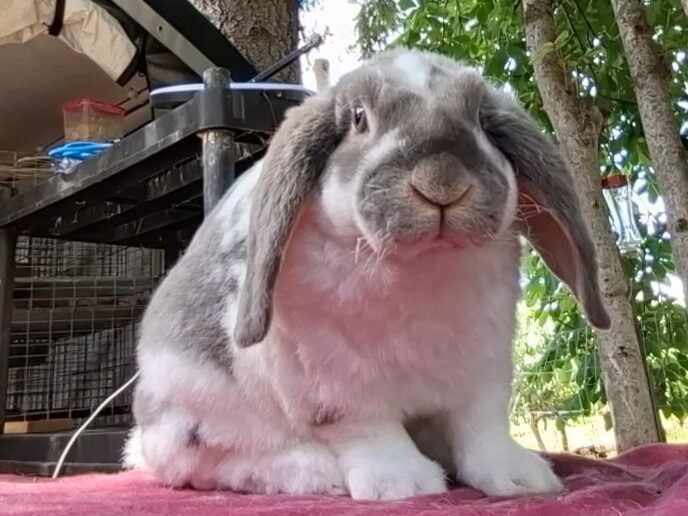
European Plush Lops
About Our European Plush Lops
In 2023, while researching Rex-coated rabbits, I stumbled upon a breed that completely changed my perspective on rabbit keeping: the European Plush Lop. I acquired an incredible buck from Sweet Huckleberry Farms, descended from Luxembourg imports. After two decades of working with various breeds, I immediately recognized the exceptional quality of these rabbits.
While my Mini Satins and previous production rabbits have their own merits, the Plush Lop is an entirely different experience. They are remarkably soft, highly intelligent, and deeply curious. I was so captivated by the dedication of the founding rabbitries that I made the easy decision to dedicate half of my barn to preserving and refining these genetics in North America.
Understanding the Plush Lop
Our foundation genetics are primarily traced back to Greetje’s or Malvina Lakes lines, imported through esteemed breeders like Huckleberry, Blewett, and Fuzzy Peach. We are committed to protecting and promoting these specific bloodlines.
These rabbits make phenomenal pets; they are social, engaging, and bond intensely with their human companions. However, they are also highly territorial. Because of their high hormone levels, we consider early desexing essential for owners to enjoy the full potential of these exotic, companion-oriented rabbits.
Note to Prospective Breeders: As this is still a “breed in development” with limited genetic diversity in North America, we require interested breeders to demonstrate a strong foundation of knowledge and meet specific standards before we place breeding-quality stock.
Check out what we’ve got available!
The Working Standard
The European standard for the Mini Plush Lop (often categorized as the “Plush Lop” or “European Mini Plush Lop” in show participating countries) is fundamentally focused on a balanced, elegant, and athletic animal. Unlike the American lines, which lean heavily toward a stockier, ultra-compact, Holland Lop-style dwarf type, the European standard values a slightly longer, highly functional build and precise features. [1, 2, 3, 4, 5]
The definitive judging criteria, body structure expectations, and color faults for European lines are structured as follows:
Point Breakdown (100-Point Scale)
The allocation prioritizes overall balance, a clean type, and coat density: [1, 6]
- Body & Conformation: 25 points
- Head: 20 points
- Fur (Density & Texture): 20 points
- Crown: 12 points
- Feet & Legs: 10 points
- Ears: 8 points
- Color & Markings: 5 points [6]
Body Type & Conformation (25 Points)
The European type requires a firm, muscular animal that stands distinctly off the ground. [1, 7]
- Structure: A “bean-shaped” but well-muscled body. The midsection should be broad enough to create a smooth, clean taper from the large hips down to the shoulders. [7]
- Hindquarters: Large, rounded, and powerful, displaying a clear “springiness” when moving. The tail must be carried tightly against the rump. [7]
- Severe Body Faults: Rolls of fat around the midsection; an undercut or narrow, pinched hindquarters; a midsection that is wider than the hindquarters; or a “screw tail”. [7]
Head, Crown, and Ears (40 Points Total)
The head is where European lines diverge most sharply from American dwarf styles. [1, 8]
- Head (20 Points): Balanced with the body, featuring a shorter wedge or pear-shaped profile with a prominent muzzle. The lines must be completely clean and free from excess fat, flesh, or a dewlap. Bucks should look masculine and wide; does should be more refined to accentuate large, bright eyes.
- Crown (12 Points): A subtle, defined ridge of cartilage wrapped cleanly from behind one eye, over the top of the skull, to the other eye. It must contain dense fur and sit level with the top of the head to force a true vertical ear drop.
- Ears (8 Points): Must lop vertically flat against the cheeks. However, the European standard permits some natural mobility/expressiveness in the ears.
- Head & Ear Faults: A large dewlap; an overly large muzzle; small, unbalanced eyes; or an overly flat, round face that mimics a Holland Lop. [1, 9]
Feet, Legs, and Bone (10 Points)
- Expectation: The bone should be strong and finely made, rather than heavy or coarse. Forelimbs must be straight and relatively long, showing a soft angulation at the wrist joint so the rabbit can move gracefully “on its toes”. Hind feet must look large and wide with great fur coverage and strong nails. [1]
Fur (20 Points)
- Expectation: A true, low-maintenance Rex-type coat. It must be exceptionally dense, plush, and velvety. The hair shaft is slightly longer than a standard Rex, anchored by soft, perfectly upright guard hairs. [10, 11]
Color, Marking Classifications & Faults (5 Points)
While all standard colors and patterns are accepted, they are divided into specialized show classifications: [6]
- Solid Pattern: Clean, uniform color distribution across the body.
- Broken Pattern: Balanced, clear patches of color on a white background.
- White Eared: Distinctive white ears balancing the face color.
- Vienna (VM/VC): Marked by clean, specific expression of the Vienna gene (often including blue or marbled eyes).
- Color Faults: Severe brindling (stray hairs of an un-matched color) in solid classes, patches of white on solid-show animals (outside of recognized silvering/agouti ticking), faded or “washed out” undercolor, or structural mismatches where face and body markings lack clear definition. [6]
References
- [1] https://en.wikipedia.org
- [2] https://auraroserabbitry.com
- [3] https://www.facebook.com
- [4] https://www.facebook.com
- [5] https://operonstrategist.com
- [6] https://plushifur.com
- [7] https://en.wikipedia.org
- [8] https://plushifur.com
- [9] https://www.elliesrabbitry.com
- [10] https://www.shadygroverabbitry.com
- [11] https://www.facebook.com